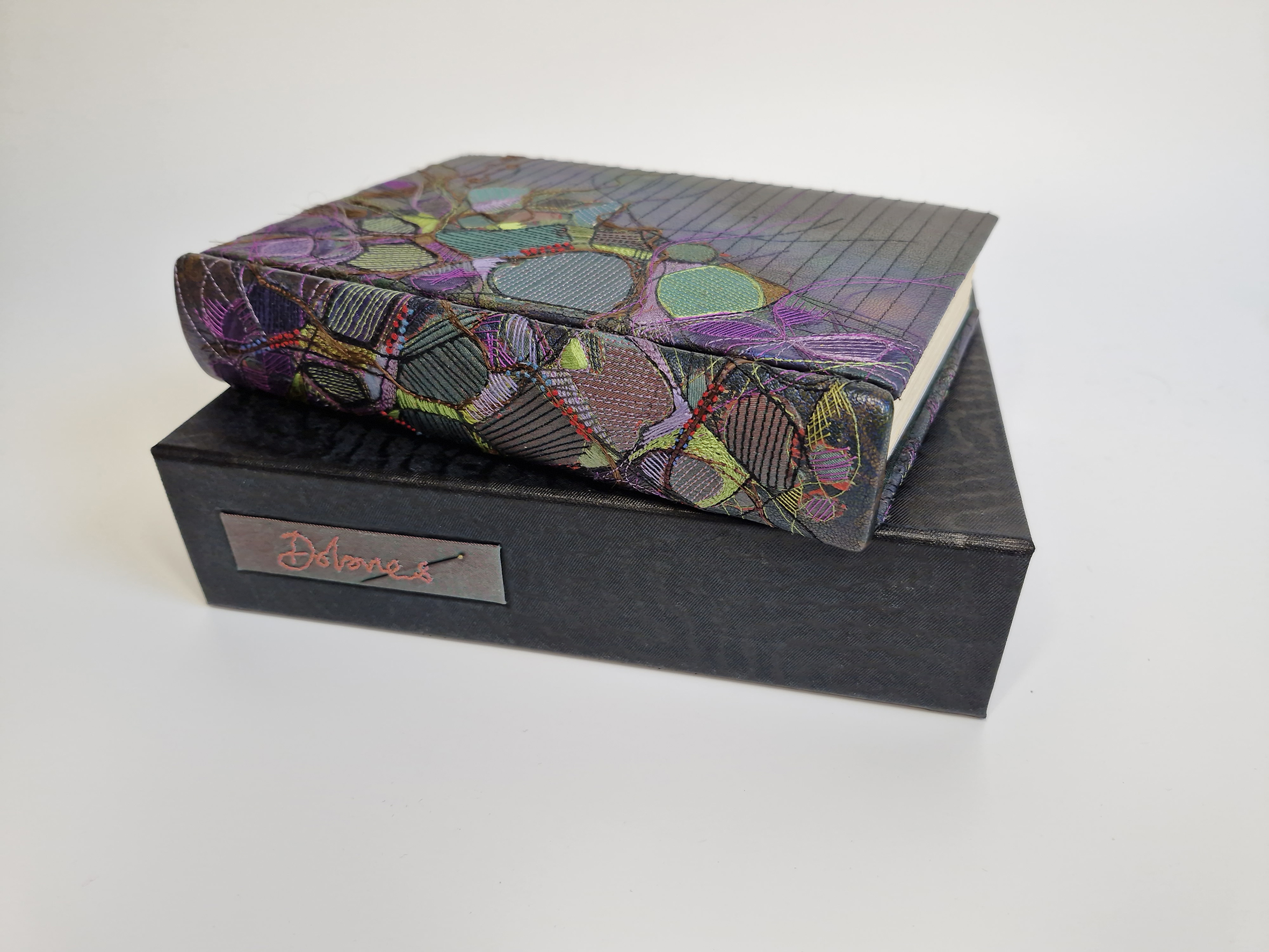
Vladimir Nabokov, Lolita. Bound by Sue Doggett, 2025.
Bookbinder's Statement
Everyone is aware of Lolita or has an idea of what they think Lolita is about, even what ‘a Lolita’ is, and of course there is a whole mythology surrounding this difficult novel. The subject matter is so hard to read, especially having grown up in a society where women are routinely (1 in 30 for the year 2022) sexually assaulted.
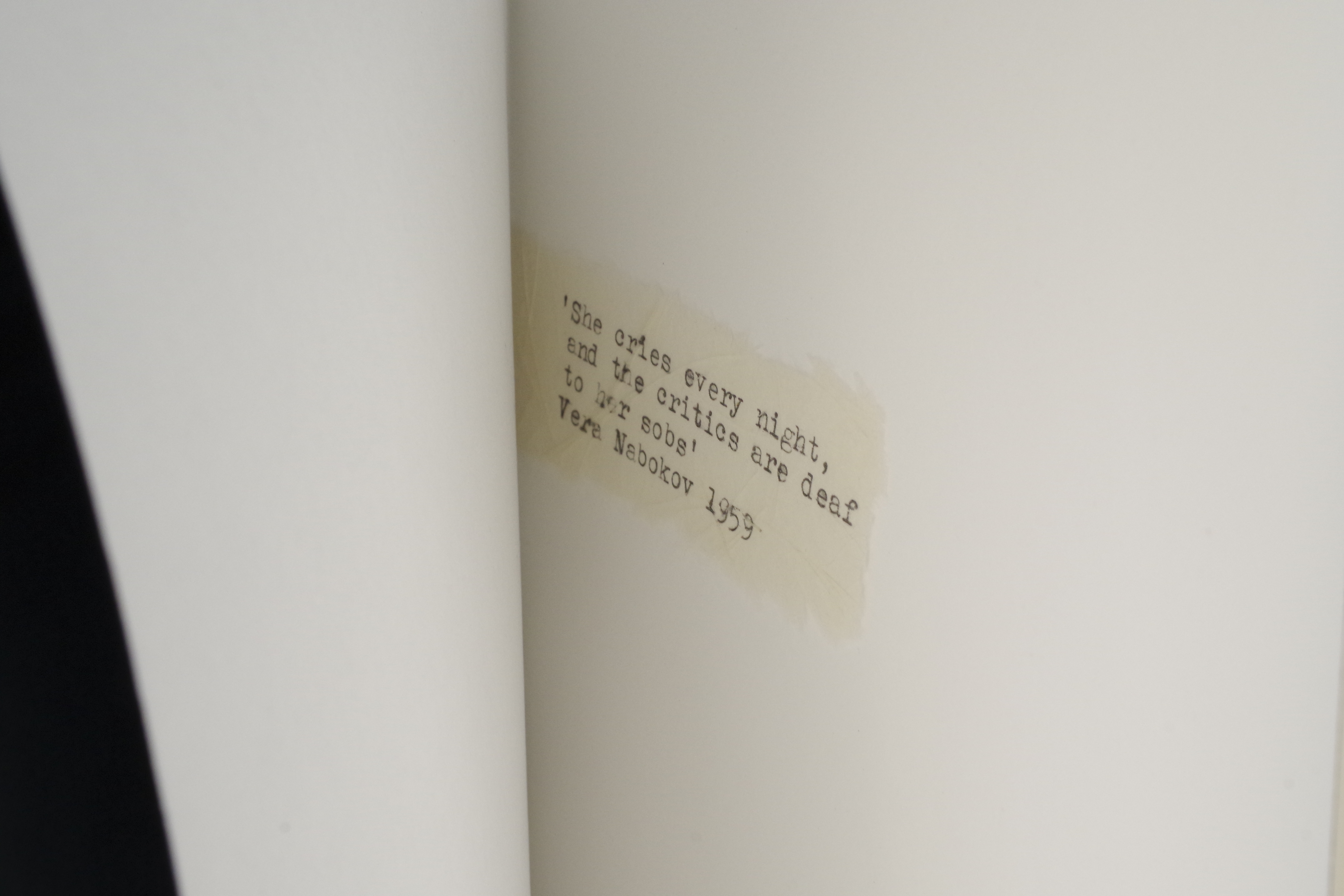
For me, Lolita is a book about violence and destruction. Apart from the obvious horror of the continuous abuse, it is also an inherently sad novel, where a young girl is isolated from other girls and from her mother, and who is forced into a horrific relationship with Humbert Humbert, from which the only escape is into the arms of another paedophile. However, as a reader, the events of the narrative are presented for you through the destabilising prose of HH which is unsettling, and forces you into a constant state of disequilibrium.
So, I thought, always keep Lolita in mind and put her at the heart of whatever you make, but do it from a perspective of what’s being done to her, not in an image of her as imagined by a third person. HH and Lolita travel (without any real destination in mind but just to keep moving and to keep her captive) to many places, some real and some imagined, transiting through a "crazy quilt" of American states.
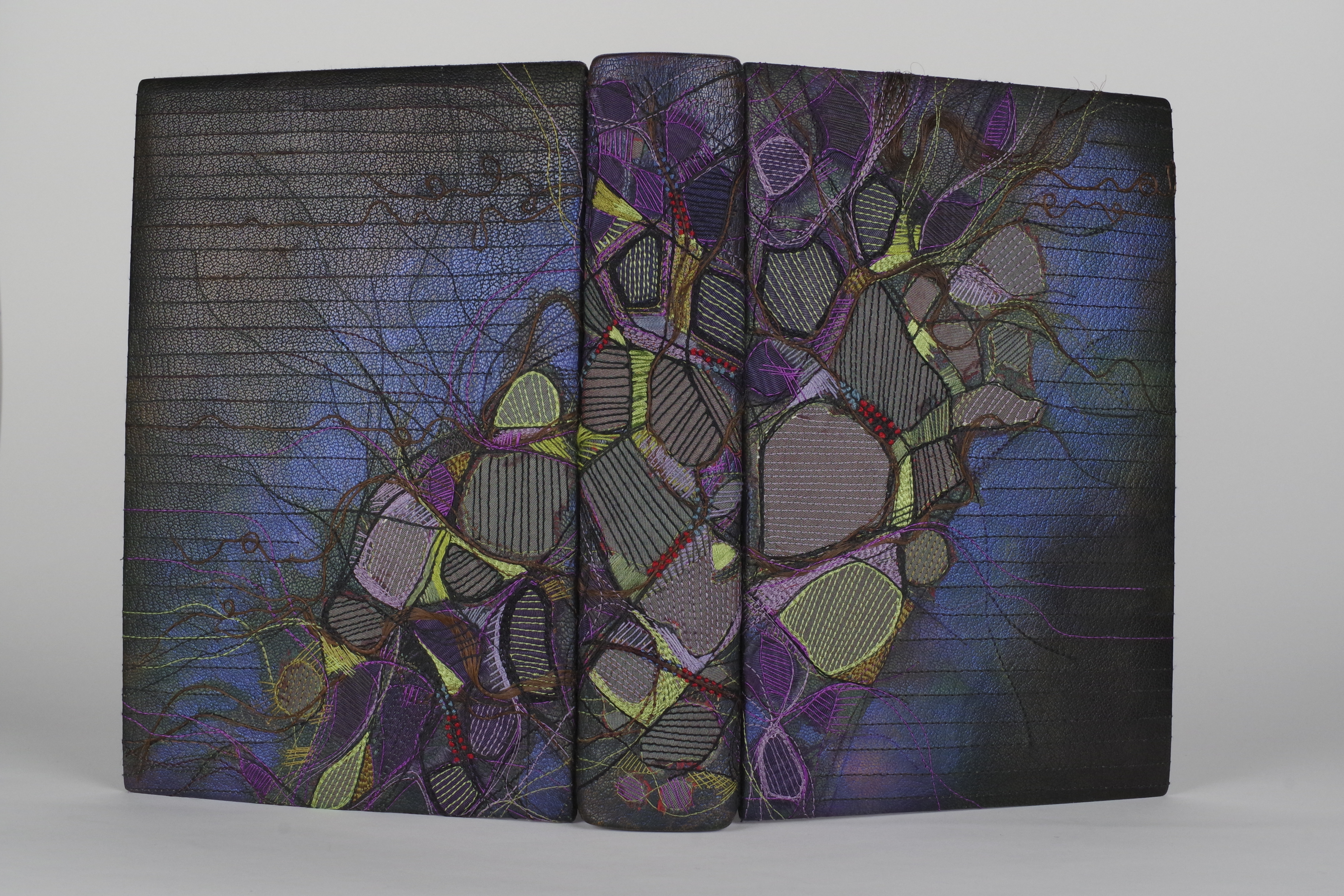
With no particular configuration in mind, I cut field-like shapes out of two-tone and moiré book cloth which were pared to fray the edges and pasted on to the (already) pared and dyed goatskin. The reason for using materials that were not visually static was to emphasise the unreliability of the narrative and the constant state of flux that the reader finds themselves in. After all the onlays were applied, I used a mixture of machine and hand embroidery to render details of fields, roads, plough lines etc. to build up the textural landscape. Some lines were left trailing over the covers as I had a vague idea that they would eventually lead into something else.
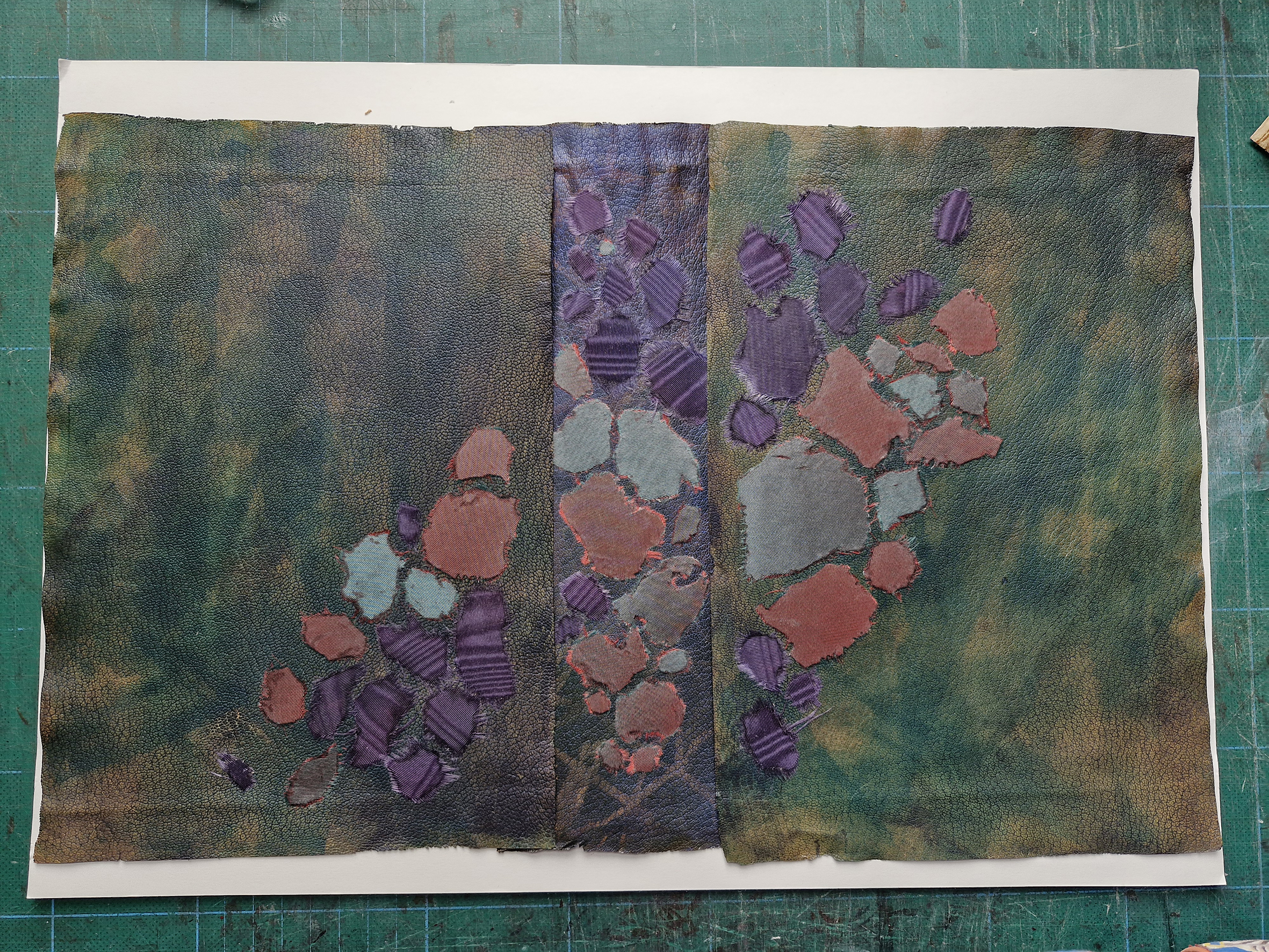
Apparently, Nabokov started to write Lolita on butterfly hunting trips that he and Vera took during the 1950s and beyond. Lolita meets a fate comparable to that of a caught butterfly, immobilised and pinned down on a collector’s spreading board. I chose to see HH as a harmful collector, akin to Étienne Léopold Trouvelot, a French amateur entomologist who in the 1860s accidentally let loose the Spongy Moth which has been responsible for the destruction of millions of hardwood trees across the USA. Like the moth, HH is European, and you could say that he behaves in a similar way to the moth, destroying young shoots by stripping away the outer covering of the stems which leaves them, in this case Lolita, vulnerable to other pathogens (in the form of HH's nemesis, Quilty). HH is represented in this binding, in a tiny way only - by the blue and red spots (in pairs of 6 red and 5 blue) which are characteristic of the Spongy Moth caterpillar and which appear on the binding and in the endband colours.
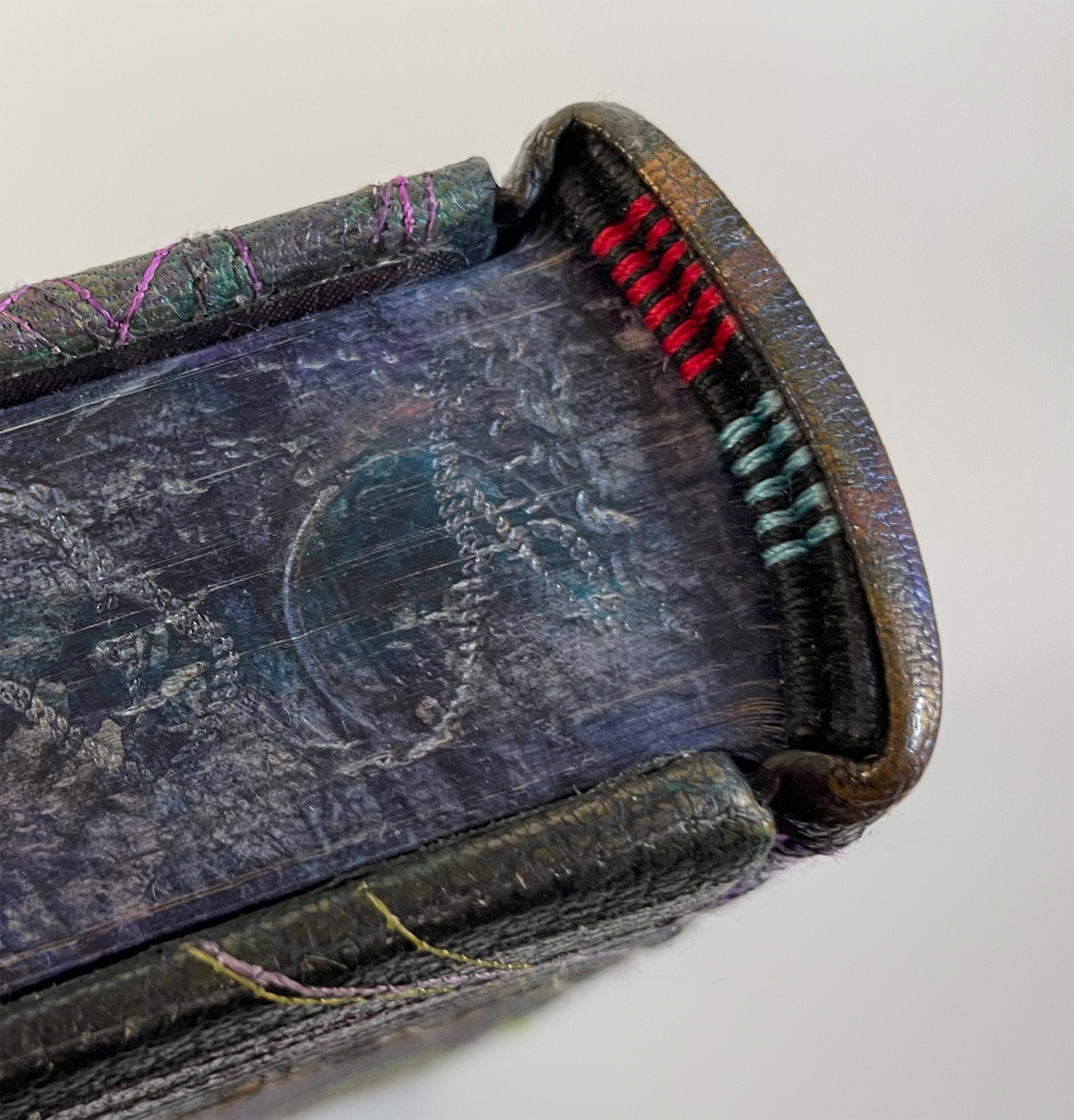
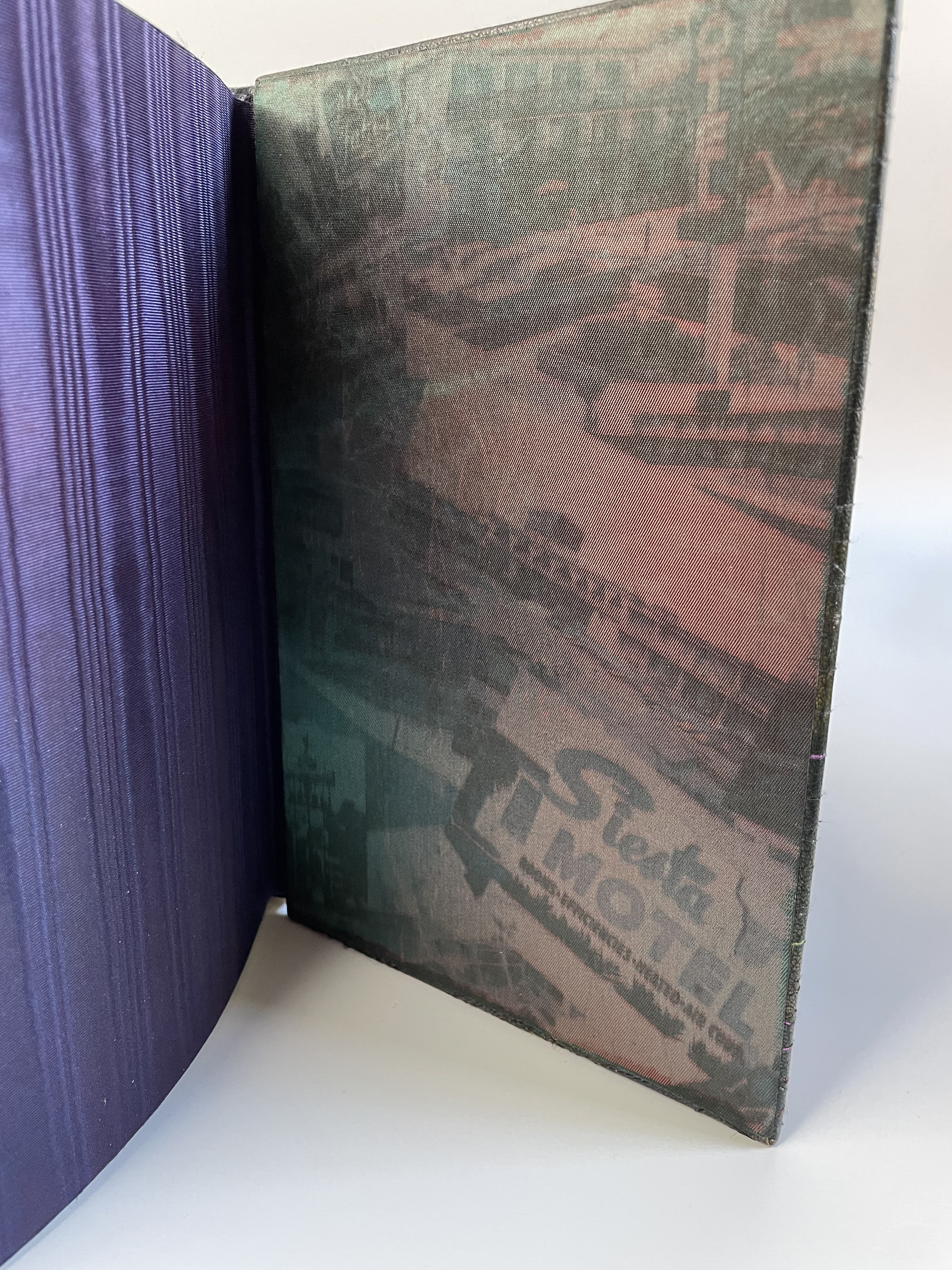
Apart from the blue and red spots already discussed, the overarching colour palette of the binding is based on all the hues a bruise goes through from its deepest purple to its palest yellow. To visualise how I really felt about the novel, the design had to be something that was appealing on the surface, but with an underlying nastiness. I used the idea of a bruise because it appears as a visible mark on the skin which indicates an underlying trauma to the body. Although one may see the colours as alluring and potentially attractive, they are not what they seem. I used a two-tone bookcloth for some of the ‘field’ pieces so that when you move the book around, they change colour. I also use the Moiré silk for the endleaves for the same reason. It also seemed to speak of ‘Old Europe’ and I deliberately chose the end of the roll of cloth that was faded and marked so that it wasn’t perfect.
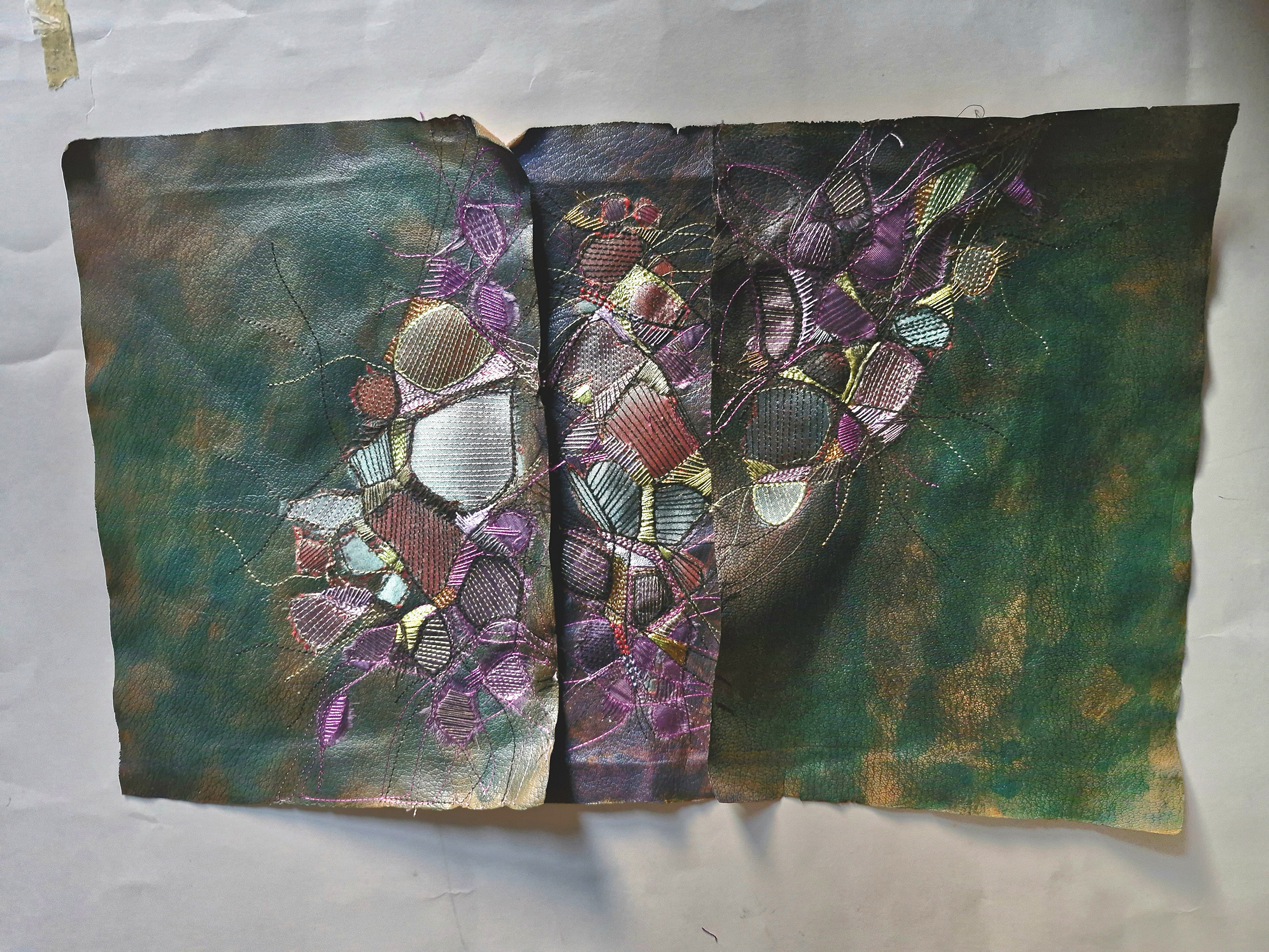
The final addition to the covers, and the element that has become the most important, was made when I asked my daughter if I could use her teenage hair. She has had long hair for most of her life with the occasional and significant cut to the length and I have kept her hair from these cuts. It was important to me that we talked about how I would use it and it was in discussion with her about 'Lolita' and its implications, that the hair became a potent visual element of the design. When this hair was cut, it was chestnut brown and because HH tells us that Lolita has ‘the same chestnut head of hair’ as his first love Annabel Leigh, there was another layer of relevance. Hair does funny things to people, depending on the context in which we find it. Hair is a common feature in folklore, witchcraft and mythology because it seems at once both living and dead and because the hair follicle contains the very basis of our essence in the form of DNA, it is a troubling substance.
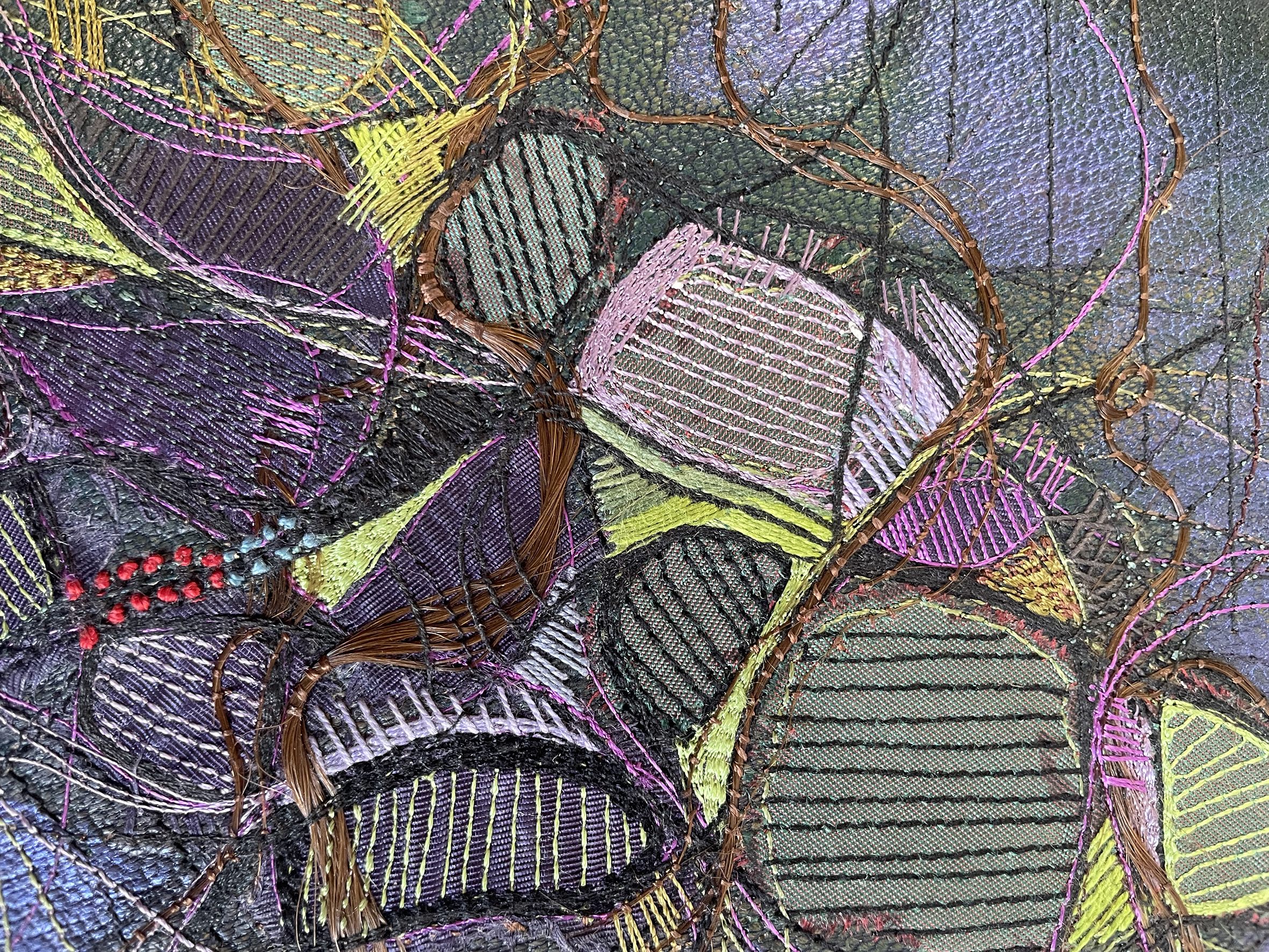
The hair forms a sinuous link between the imaginary landscape of the book’s surface and the parallel lines that are sewn down the front and back covers. It is placed onto the book and couched with tiny stitches to hold it in place. There is always the possibility that over time, little pieces might work their way loose through handling. The horizontal lines are indications of where a text might be and Lolita, in the form of the chestnut hair, is unravelling and escaping from both text and location. Finally, I decided to label the box not with Lolita, the title of the book, but with Dolores, to give the heroine of the story her proper name. She is held in place by an entomologist’s pin.